Research Overview
Shellfish pathogens in the Chesapeake Bay
Economically and environmentally important species in the Chesapeake Bay are impacted by a spectrum of protozoan, bacterial, and viral diseases. Episodic and large-scale mortalities of clams, oysters, and blue crabs result in multi-million dollar losses for the fishery. Human activity contributes to outbreaks by degrading water quality in estuaries, by introducing new pathogens in ballast water, and by intentional movement of shellfish.
Viruses in the blue crab
For over 30 years, scientists at the Cooperative Oxford Lab on the eastern shore of MD have documented viruses of all types in blue crab (Callinectes sapidus). Application of molecular techniques now offers us the chance to understand more about the prevalence and health effects of these viruses. One virus of particular concern is the reo-like virus. It has been associated with crab mortality in soft-shell crab facilities, and is an agent of concern for any future blue crab qauaculture operation. Characterization of the double-stranded RNA genome of this virus is underway, with the goal of developing a PCR-based probe to monitor it in the environment and in aquaculture
|
Research DescriptionResearch Areas: Molecular parasitology
Research Specialties: Molecular detection of estuarine pathogens, molecular characterization of blue crab pathogens, viruses in the blue crab.
Research Interests
- The protozoan pathogen of blue crab, Hematodinium sp.
- Genomic characterization of RNA viruses of the blue crab.
- Development of tools for identifying and monitoring blue crab pathogens in aquaculture and in the environment.
The blue crab is the trademark shellfish of the Chesapeake Bay, and the combined harvest of blue crabs in MD and VA is valued at over $60 million per year. Populations and harvests of blue crab in the Chesapeake Bay have been at alarmingly low levels for a decade . While fishing pressure is by far the dominant force driving this decline, the role of disease is crab mortality is unknown but potentially significant.
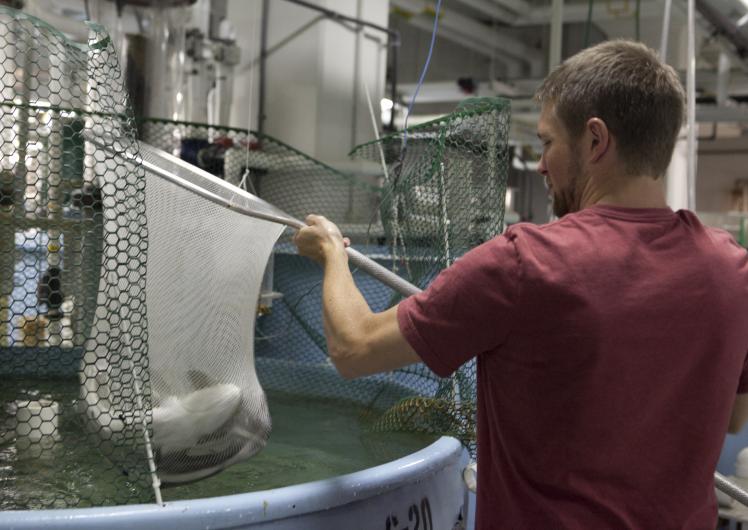
In the face of declining blue crab harvests, one possible avenue for added value in the industry is soft-shell crab production. Unfortunately, soft-shell facilities may suffer episodic mortalities of up to 25%. A combination of state of the art technology with practical field-based and aquaculture–based solutions are needed to predict or reduce mortalities.
|
Representative Publications
Nagle, L., Place, A., Jagus, R., Schott, E.J., Messick, G. and Pitula, J.S. 2006. Real-time Quantitative PCR-based assay for enhanced detection of Hematodinium sp. infection and tissue Invasion in the blue crab (Callinectes sapidus). In revision for Dis Aquat Org.
Zohar, Y., Hines, A.H., Zmora, O., Johnson, E.G., Lipscius, R.N., Seitz, R.D., Eggleston, D.B., Place, A.R., Schott, E.J., Stubblefield, J.D., Chung, J.S. 2008. The Chesapeake Bay blue crab (Callinectes sapidus): a multidisciplinary approach to responsible stock replentishment. Reviews in Fisheries Science 16: 25-35.
Schott, E. J., Alavi, M., Fernandez Robledo, J-A., Pecher, W. T., and G. R. Vasta. Application of PCR probes to monitor pathogen persistence and transmission in C. ariakensis maintained in recirculating aquaculture. Accepted in J. of Shellfish Res.
Complete Listing...
|