comb
Blue Crab Research Print Print   Email Email  

In just two years since the inception of an innovative research and development effort, COMB scientists were able to close the entire life cycle of the Chesapeake blue crab in captivity and to mass-produce thousands of 20 mm (0.75 inch) juvenile crabs in laboratory tanks. In a joint project with our partners at the Smithsonian Environmental Research Center (SERC), over 25,000 of the COMB crabs were individually tagged and released to the Chesapeake Bay, where they are monitored for survival, growth, habitat use and movement patterns. This work is part of a multidisciplinary research program aimed at better understanding the basic biology of the blue crab and examining the potential of replenishing its declining fishery. The program was initiated in the summer of 2000 through funding from the State of Maryland and Phillips Seafood Inc. and the efforts of the Maryland Watermen's Association. Additional Federal funding provided through the Chesapeake Bay Office of NOAA, enabled the expansion of the research and the formation of the Blue Crab Advanced Research Consortium (BCARC), which also includes the States of Virginia (Virginia Institute of Marine Sciences), North Carolina (North Carolina State University) and Mississippi (University of Southern Mississippi).

This program was initiated in response to the sharp declines in blue crab harvests over recent years. The first and foremost objective is to unveil the poorly understood, yet complex, basic biology and life cycle of this economically and ecologically important crustacean. We are applying, for the first time, the tools of modern biology to better understand the fundamental processes involved in blue crab reproduction, early development, molting, growth and aggression and also to develop blue crab hatchery technologies. We are releasing individually tagged hatchery crabs to investigate behavior, growth, habitat requirements, and survival of blue crabs in the Chesapeake Bay as well as to assess the potential of rebuilding the reduced Chesapeake stocks.


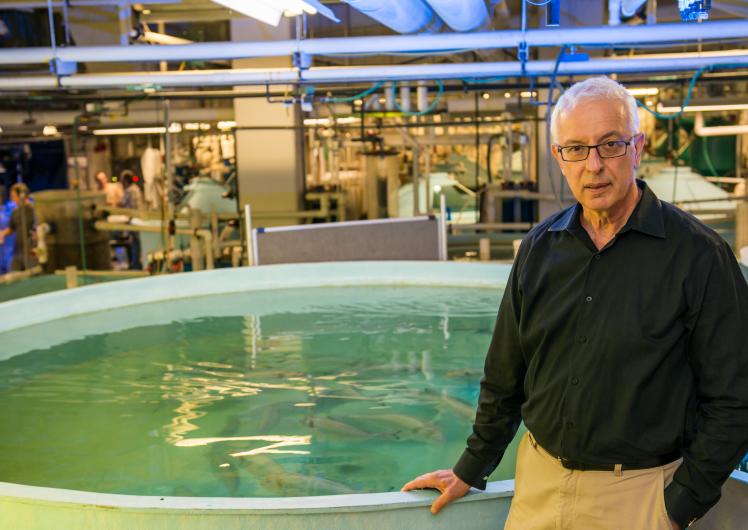
The partnership's researchers started with mated Chesapeake Bay blue crab females. Placed in marine tanks at COMB's Aquaculture Research Center, the crabs were exposed to phase-shifted environmental conditions, which resulted in year-round spawning. Individual females spawned several million free-swimming blue crab larvae. The larvae were fed with microscopic algae and zooplanktonic organisms and went through 9 larval stages before metamorphosing into tiny crabs at 4 weeks of age. Optimizing the complex feeding regimen of the larvae resulted in excellent survival rates through larval rearing of up to 70%. The next hurdle is that the tiny crabs use their claws to attack their siblings. Experiments carried out to reduce aggression and cannibalism demonstrated that providing shelter structures, ample amounts of diversified food, enough elbow room, as well as sorting the baby crabs by size, resulted in excellent survival rates of the tiny crabs. Analyses are being performed to determine the optimal balance between maximizing the tank densities and maximizing survival rates, in an effort to scale up the cost-effective mass production of juvenile crabs. At intensive conditions, around 45-50% of the baby crabs survived through 6-7 captive molts to reach 20 mm of size by 9 weeks of age. It took COMB scientists a little over a year to optimize the culture parameters and develop intense hatchery technologies to produce thousands of healthy juvenile crabs for the ongoing studies of the blue crab life cycle and of rebuilding the reduced Chesapeake population. It is important to note that these crabs retain the unaltered genetic composition of their Chesapeake parents.

Over the summer of 2002, COMB produced 40,000 juvenile crabs (0.5-1.5 inches in size). Twenty-five thousand of those hatchery crabs were individually tagged and released to study sites in the wild by SERC scientists. To distinguish hatchery crabs from wild crabs, all hatchery crabs are tagged before release. We have tested and employed two methods for tagging crabs that will last through the series of molts as small hatchery crabs grow: tiny injections of either colored plastic (see photo) or magnetized wire. COMB scientists are now developing new genetic identification approaches to monitor hatchery and wild crabs, using DNA fingerprinting technologies.

SERC scientists have followed the groups of tagged hatchery crabs for up to 14 weeks after their release. In this first summer following release, the hatchery crabs have grown to almost 5 inches (12.5 cm) carapace width at the age of 6 months. At this size, the crab is approaching maturity and will soon be able to contribute reproductively to the Bay's blue crab population. Future research will also test for optimal conditions and procedures for survival, growth and migration to spawning areas by hatchery crabs. VIMS and SERC scientists are also using small crabs caught in the Bay to release at study sites to test the feasibility of increasing crab abundance. These experiments will allow further comparisons of hatchery-reared crabs with wild crabs.

Initial experiments show that hatchery crabs behave similarly to wild crabs. For example, COMB crabs raised on a hatchery diet readily begin feeding on natural prey at rates similar to wild crabs.
Other experiments are teaching us ways to promote survival of released hatchery crabs. Crabs reared in hatchery tanks without bottom sediments have lower survival until they gain experience burying to escape predators. We are testing procedures to give hatchery crabs experience with natural sediments prior to release.

Based on the findings of the ongoing and future research, we plan to establish a large-scale blue crab prototype hatchery/nursery to be used for studies of blue crab biology and ecology and for testing the feasibility of stock enhancement in the Bay.

For additional details please contact:

Dr. Yonathan Zohar
Director and Professor
Center of Marine Biotechnology
University of Maryland Biotechnology Institute.

comb home umbi home